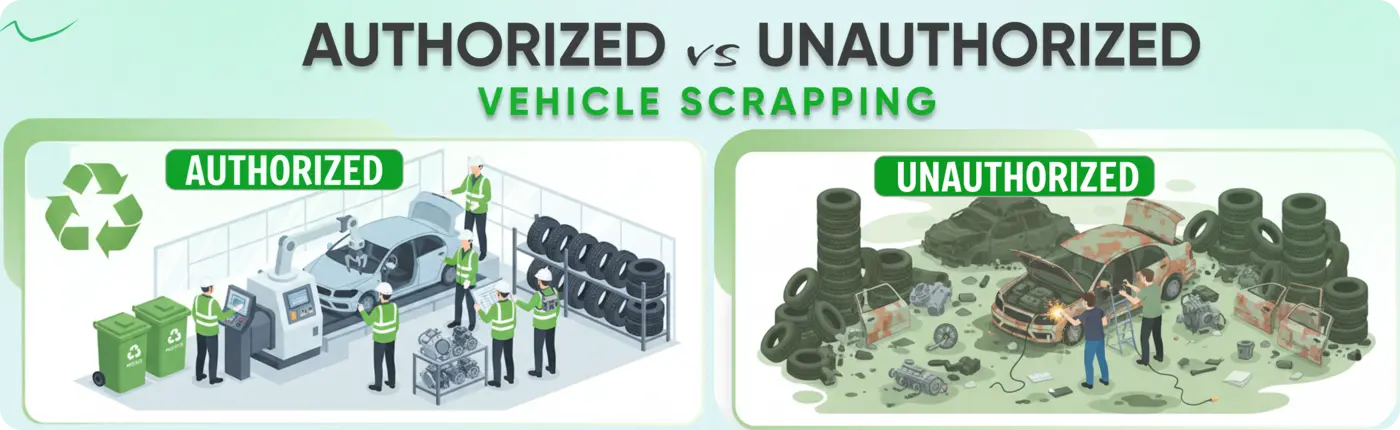
Vehicle scrapping in India involves applicable regulatory, documentation, and environmental requirements. Understanding the difference between an authorised Registered Vehicle Scrapping Facility (RVSF) and an informal scrap dealer can help vehicle owners make informed decisions. Before handing over a vehicle, verify the facility's authorisation, clarify the documentation process, and understand the agreed payment terms.
Key Points:
- An authorised RVSF processes vehicles under the applicable vehicle-scrapping rules.
- The facility processing the vehicle issues the applicable Certificate of Deposit (CoD) and Certificate of Vehicle Scrapping (CVS) through the Government of India's VAHAN system.
- Before choosing a service, verify the facility's authorisation and confirm the documentation, payment, and registration-closure procedures.
- Tax concessions and other incentives depend on applicable rules and eligibility conditions.
How Unauthorized Scrapping Works
Problems can arise when a vehicle is handed over to a scrap dealer who cannot provide the required documentation or demonstrate that applicable scrapping and registration-closure procedures have been followed. Depending on the circumstances, incomplete paperwork may make it difficult to establish the vehicle's handover and scrapping status. Verify the processing facility and keep all relevant records.
Steps Used by Unauthorized Dealers:
- Offer cash-only deals without paperwork.
- Skip RC cancellation and issue no Certificate of Deposit (COD).
- Resell usable parts to illegal refurbishers.
- Dump hazardous waste without environmental care.
Result: You stay the registered owner on government records, liable for future misuse.
Legal Differences Between Authorized and Unauthorized Scrapping
Authorized scrapping follows MoRTH’s Vehicle Scrappage Policy 2021; unauthorized scrapping violates it. Only authorized centers can issue a valid Certificate of Deposit (COD) and Certificate of Vehicle Scrapping (CVS), ensuring deregistration from VAHAN.
| Criteria |
Authorized Scrapper |
Unauthorized Dealer |
| Government Approval |
Licensed RVSF |
None |
| VAHAN Integration |
Yes |
No |
| RC Deregistration |
Automatic |
Not Done |
| Legal Safety |
100% compliant |
Owner remains liable |
| Payment Transparency |
Bank transfer + receipt |
Cash only |
| Environmental Process |
Pollution-controlled dismantling |
Hazardous dumping |
Documents You Receive from an Authorized Scrapper
Authorized scrappers issue two main documents: Certificate of Deposit (COD) and Certificate of Vehicle Scrapping (CVS). These are official proof that your vehicle is deregistered and dismantled under government norms, qualifying you for road-tax rebates.
Documents Provided:
1. Certificate of Deposit (COD):
- Proof of scrapping initiation.
- Used to claim road tax rebates when purchasing a new vehicle. In addition, some vehicle manufacturers may offer extra discounts beyond the road tax rebate.
2. Certificate of Vehicle Scrapping (CVS):
- Final proof of dismantling.
- Confirms removal of your vehicle record from VAHAN.
3. Payment Invoice/Receipt:
- Shows metal weight and valuation breakdown.
Risks of Choosing Unauthorized Scraping Dealers
Selling to unauthorized dealers can cause legal, financial, and environmental problems. Your car remains active in government records, which means if it’s reused in a crime or accident, you’re accountable. You also lose monetary benefits and risk fines.
Main Risks:
Legal Liability
- Your vehicle remains registered in your name even after selling it.
- If the scrapped chassis or engine is reused in crime, smuggling, or accidents, the RTO and police records will trace ownership back to you.
- You can face notices, challans, or even FIRs for a vehicle you no longer possess.
Example: Many unauthorized scrappers strip a car for parts and sell the body under fake RCs. On paper, the original owner is still responsible, causing long-term legal troubles.
Financial Loss
- No Certificate of Deposit (COD) means you cannot claim:
- Road-tax rebates (up to 25%) on new vehicles.
- Vehicle Manufacturer discounts are offered for scrapped vehicles under the national policy.
- You also lose the metal-weight-based valuation transparency that authorized scrappers provide.
- Unauthorized dealers often pay high cash amounts and manipulate vehicle weight or part prices.
Rsult: Legally scrapping a vehicle provides multiple upfront and future monetary benefits as incentives under the official Vehicle Scrappage Policy.
No Official Proof of Deregistration
- Authorized dealers upload all records to the VAHAN portal, triggering automatic RC cancellation.
- Unauthorized ones do not, which means your car is still shown as active.
- Without COD and CVS, you cannot prove that you’ve legally scrapped your vehicle.
Consequences:
- RC remains live → You’re still the owner.
- Insurance and RTO reminders continue.
- You may be billed for pending road tax or toll violations.
Data and Identity Misuse
- Your RC, insurance copy, or PAN may be photocopied and used to forge ownership documents.
- Fraudulent dealers can create duplicate RC books or sell your engine number to other buyers.
- This exposes you to identity misuse and legal complications if those papers are linked to crimes.
Safety Tip: Always surrender RC and number plates only after dealer verification on VAHAN.
Environmental and Ethical Impact
- Unauthorized scrapyards rarely follow pollution-control norms.
- They burn or dump hazardous materials like oil, coolant, plastic, and lead batteries into soil or drains.
- These practices violate CPCB (Central Pollution Control Board) guidelines, harming public health and local ecology.
By contrast: Authorized facilities use scientific dismantling - draining fluids, segregating metals, and recycling components safely.
Reuse of Unsafe Vehicle Parts
- Engines, axles, and braking systems from unauthorized scrapyards often enter the grey market.
- These reused parts are fitted into unsafe vehicles or reassembled illegally.
- Such actions contribute to road accidents, emissions, and mechanical failures.
Impact: Even though you sold the car, its parts may harm others - ethically and legally.
No Accountability or Support
- Once payment is made in cash, there’s no after-service or accountability.
- If your car is found in any incident later, you cannot trace or contact the dealer.
- No customer support, no grievance redressal, no documentation trail.
Remember: Mariinox is a privately owned vehicle-scrapping brand that manages and operates a network of Registered Vehicle Scrapping Facilities (RVSFs). The authorised facility processing your vehicle handles the applicable scrapping procedures and issues the relevant certificates through the Government of India's VAHAN system.
How to Verify if a Dealer Is Authorized
Verify the authorisation details of the specific Registered Vehicle Scrapping Facility that will process your vehicle. Check the facility's registered name, location, authorisation documents, and validity through the relevant official source. Ask which legal entity will process your vehicle and issue the applicable certificates. Mariinox manages and operates a network of RVSFs; the relevant facility's authorisation should be verified separately.
Steps to check dealer authorization
- Visit VAHAN Portal: https://vahan.parivahan.gov.in/
- Go to the “Vehicle Scrapping” Section.
- Select Your State/UT - e.g., Uttar Pradesh, Delhi NCR.
- Check the List of Authorized RVSFs.
- Confirm:
- Registered name matches the dealer.
- Active validity period.
- MoRTH-issued authorization number.
- Ask Dealer to Show:
- RVSF license copy.
- Sample COD/CVS format.
- Company GST invoice.
- Additional Verification Tips:
- Avoid dealers offering “cash only” without paperwork.
- Ensure payment is via official bank account.
- Ask for photos/videos of vehicle dismantling for record.
Ready to Scrap Your Vehicle?
Get a free, no-obligation quote and see how much your old vehicle is really worth — without the stress of selling.
Conclusion
Understanding the difference between an authorised RVSF and an informal scrap dealer helps you make a more informed vehicle-scrapping decision. Verify the facility's authorisation, agree on the valuation and payment terms, retain your handover records, and confirm the status of applicable registration-closure formalities. Mariinox helps vehicle owners navigate the process through its network of Registered Vehicle Scrapping Facilities, while the authorised facility processing the vehicle issues the relevant certificates through the Government of India's VAHAN system.